肯定有人问,这不是计算机博客吗?哦!诶!我就不,我想怎么写就怎么写😋
Cuda Optimize : Vectorized Memory Access
baseline
1 | __global__ void device_copy_scalar_kernel(int* d_in, int* d_out, int N) { |
简单的分块拷贝。
通过cuobjdump -sass executable.得到对应的标量copy对应的SASS代码
1 | /*0058*/ IMAD R6.CC, R0, R9, c[0x0][0x140] |
(SASS不熟悉,请看SASS一文)
其中4条IMAD指令计算出读取和存储的指令地址R6:R7和R4:R5。第4和6条指令执行32位的访存命令。
Vector way1: CUDA C/C++ standard headers
通过使用int2, int4, or float2
比如将int的指针d_in类型转换然后赋值。
1 | reinterpret_cast<int2*>(d_in) |
但是需要注意对齐问题,比如
1 | reinterpret_cast<int2*>(d_in+1) |
这样是非法的。
Vector way2: structures
通过使用对齐的结构体来实现同样的目的。
1 | struct Foo {int a, int b, double c}; // 16 bytes in size |
实际修改LD.E.64
执行for循环次数减半,注意边界处理。
1 | __global__ void device_copy_vector2_kernel(int* d_in, int* d_out, int N) { |
对应汇编可以看出
1 | /*0088*/ IMAD R10.CC, R3, R5, c[0x0][0x140] |
变成了LD.E.64
实际修改LD.E.128
执行for循环次数减半,注意边界处理。
1 | __global__ void device_copy_vector4_kernel(int* d_in, int* d_out, int N) { |
对应汇编可以看出
1 | /*0090*/ IMAD R10.CC, R3, R13, c[0x0][0x140] |
变成了LD.E.128
summary
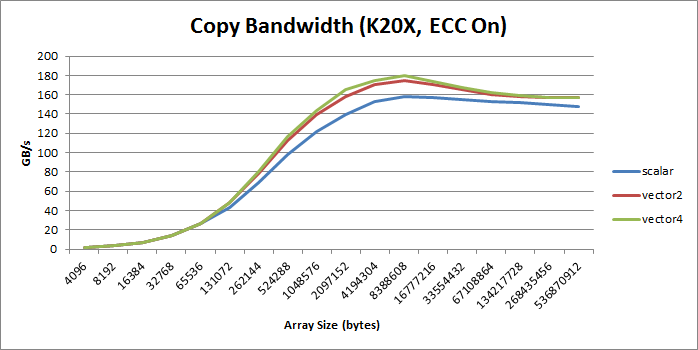
(个人感觉,提升也不大吗?也没有两倍和四倍的效果)
绝大部分情况,向量比标量好, increase bandwidth, reduce instruction count, and reduce latency. 。
但是会增加额外的寄存器(SASS里也没有看到??)和降低并行性(什么意思???)
参考文献
两种汇编
- parallel thread execution (PTX) 内联汇编有没有关系
- PTX是编程人员可以操作的最底层汇编,原因是SASS代码的实现会经常根据GPU架构而经常变换
- https://docs.nvidia.com/cuda//pdf/Inline_PTX_Assembly.pdf
- ISA指令手册 https://docs.nvidia.com/cuda/parallel-thread-execution/index.html#instruction-set
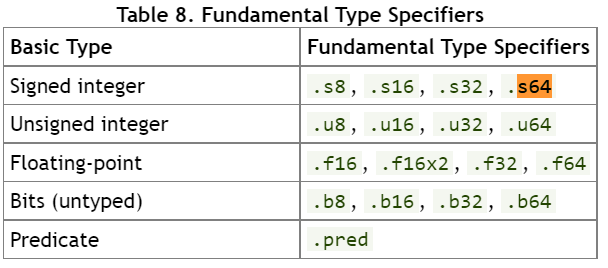
- SASS
- Streaming ASSembly(Shader Assembly?) 没有官方的证明
- 没有官方详细的手册,有基本介绍:https://docs.nvidia.com/cuda/cuda-binary-utilities/index.html#ampere
- https://zhuanlan.zhihu.com/p/161624982
- 从可执行程序反汇编SASS
SASS 指令基本信息
对于Ampere架构
指令方向
1 | (instruction) (destination) (source1), (source2) ... |
各种寄存器说明
RXfor registersURXfor uniform registersSRXfor special system-controlled registersPXfor predicate registersc[X][Y]for constant memory
SASS 举例说明1
SASS的难点在于指令的后缀。由于手册确实,需要结合PTX的后缀查看
1 | /*0028*/ IMAD R6.CC, R3, R5, c[0x0][0x20]; |
line1
1 | /*0028*/ IMAD R6.CC, R3, R5, c[0x0][0x20]; |
Extended-precision integer multiply-add: multiply R3 with R5, sum with constant in bank 0, offset 0x20, store in R6 with carry-out.
c[BANK][ADDR] is a constant memory。
.CC means “set the flags”
line2
1 | /*0030*/ IMAD.HI.X R7, R3, R5, c[0x0][0x24]; |
Integer multiply-add with extract: multiply R3 with R5, extract upper half, sum that upper half with constant in bank 0, offset 0x24, store in R7 with carry-in.
line3
1 | /*0040*/ LD.E R2, [R6]; //load |
LD.E is a load from global memory using 64-bit address in R6,R7(表面上是R6,其实是R6 与 R7 组成的地址对)
summary
1 | R6 = R3*R5 + c[0x0][0x20], saving carry to CC |
寄存器是32位的原因是 SMEM的bank是4字节的。c数组将32位的基地址分开存了。
first two commands multiply two 32-bit values (R3 and R5) and add 64-bit value c[0x0][0x24]<<32+c[0x0][0x20],
leaving 64-bit address result in the R6,R7 pair
对应的代码是
1 | kernel f (uint32* x) // 64-bit pointer |
SASS Opt Code分析2
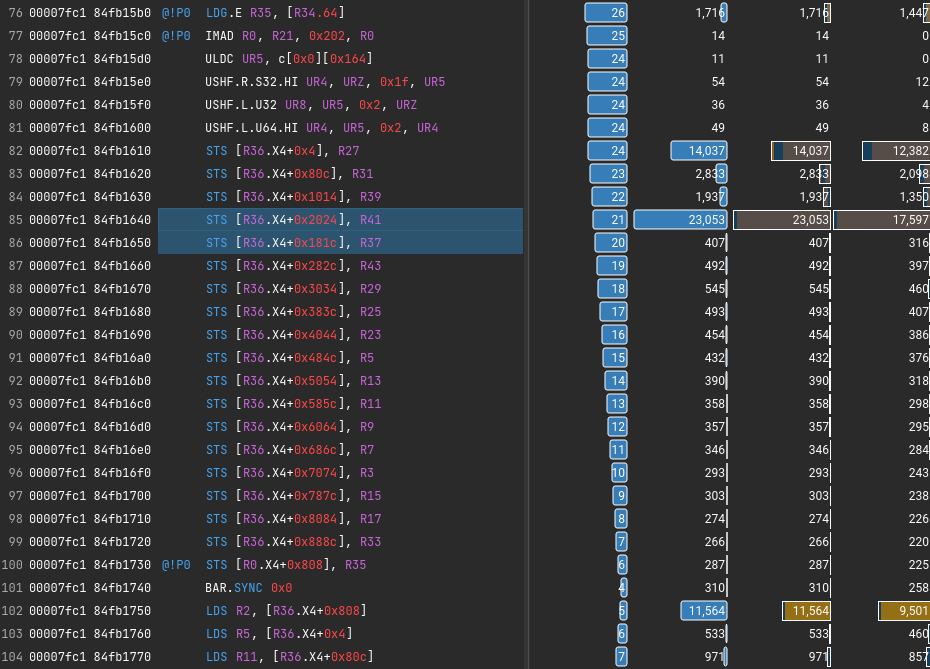
- LDG - Load form Global Memory
- ULDC - Load from Constant Memory into Uniform register
- USHF - Uniform Funnel Shift (猜测是特殊的加速shift)
- STS - Store within Local or Shared Window
流水STS
观察 偏移
- 4
- 2060(delta=2056)
- 4116(delta=2056)
- 8228(delta=2 * 2056)
- 6172(delta=-1 * 2056)
- 10284(delta=2 * 2056)
- 12340(delta=2056)
可见汇编就是中间写反了,导致不连续,不然能隐藏更多延迟
STS缓存寄存器来源
那么这些寄存器是怎么来的呢?感觉就是写反了
1 | IMAD.WIDE.U32 R16, R16, R19, c[0x0][0x168] |
Fix
原因是前面是手动展开的,假如等待编译器自动展开for循环就不会有这个问题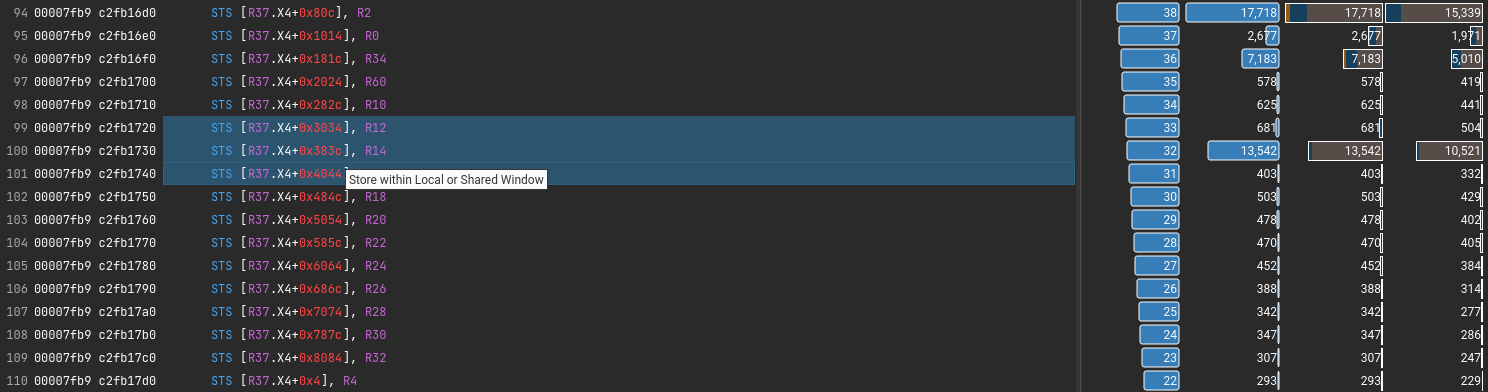
需要进一步的研究学习
暂无
遇到的问题
暂无
开题缘由、总结、反思、吐槽~~
参考文献
https://forums.developer.nvidia.com/t/solved-sass-code-analysis/41167/2
课程报告PPT
有对应的PPT,代码。
最终将1000ms程序优化到1~2ms
乔良师兄有根据知乎介绍如何利用寄存器文件缓存
SMEM难点: 跨线程访存
- 不仅每个线程需要访问自己划分对应区域之外的元素
- 而且访问的总个数也不是线程数对应的倍数
导致Embarrassingly Parallel Problems
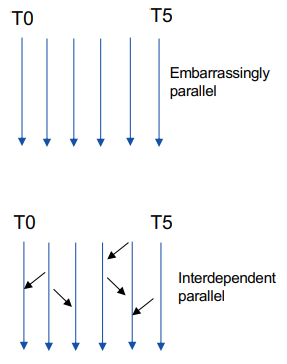
1D 梯度计算 Stencil实例
计算某点的梯度,需要前后的function值。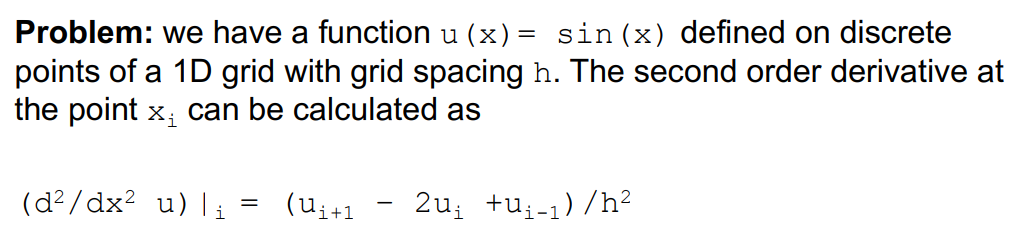
Halo/Ghost Cells 光晕
问题:
对于边界上的cells,需要访问相邻区域的元素。
解决办法:
将他们也加入进当前block的SMEM
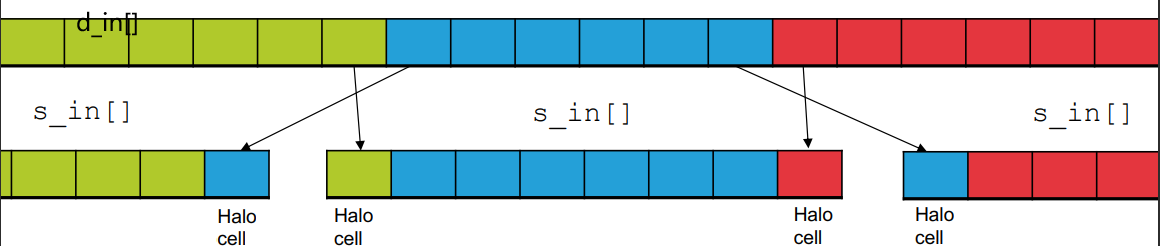
Indexing with Halo Cells
- Stencil问题的半径 radius (RAD) 是边缘元素需要的某方向的额外元素
- 在梯度的例子里是1
- SMEM声明的大小,需要在每个维度上都增加 2*RAD的个数
- 这导致SMEM的index的每个维度需要增加RAD.
s_idx = threadIdx.x + RAD;
code
1 | int main() { |
Kernel Launching
1 | #define TPB 64 |
Kernel Definition
1 | __global__ void ddKernel(float *d_out, const float *d_in, int size, float h) { |
需要进一步的研究学习
暂无
遇到的问题
暂无
开题缘由、总结、反思、吐槽~~
研一下USTC并行计算自己的选题
参考文献
CSS (Cascading Style Sheets) 和 SCSS (Sassy CSS) 都是用于样式表的编程语言,用于定义网页的外观和布局。
Outline
- General optimization guidance
- Coalescing memory operations
- Occupancy and latency hiding
- Using shared memory
- Example 1: transpose
- Coalescing and bank conflict avoidance
- Example 2: efficient parallel reductions
- Using peak performance metrics to guide optimization
- Avoiding SIMD divergence & bank conflicts
- Loop unrolling
- Using template parameters to write general-yet-optimized code
- Algorithmic strategy: Cost efficiency
CUDA 优化策略
基础
- 最大化并行独立性
- 最大化计算密度
减少数据传输
- 数据可以直接在GPU生成。
- 一次大传输也比分开的小批次快
zerocopy
如果我们数据只会在 GPU 产生和使用,我们不需要来回进行拷贝。
https://migocpp.wordpress.com/2018/06/08/cuda-memory-access-global-zero-copy-unified/
简而言之,在 host 使用命令:cudaHostRegisterMapped
之后用 cudaHostGetDevicePointer 进行映射
最后解除绑定 cudaHostUnregister
即,
1 | // First, pin the memory (or cudaHostAlloc instead) |
cuda warp shuffle
只要两个thread在 同一个warp中,允许thread直接读其他thread的寄存器值,这种比通过shared Memory进行thread间的通讯效果更好,latency更低,同时也不消耗额外的内存资源来执行数据交换。ref
访存连续性
- Optimize for spatial locality in cached texture memory ???
- 避免bank conflict: 如果没有bank冲突的话,共享内存的访存速度将会非常的快,大约比全局内存的访问延迟低100多倍,但是速度没有寄存器快。然而,如果在使用共享内存时发生了bank冲突的话,性能将会降低很多很多。
Global Memory:coalesced access
对齐(Starting address for a region must be a multiple of region size)集体访问,有数量级的差异Coalesced
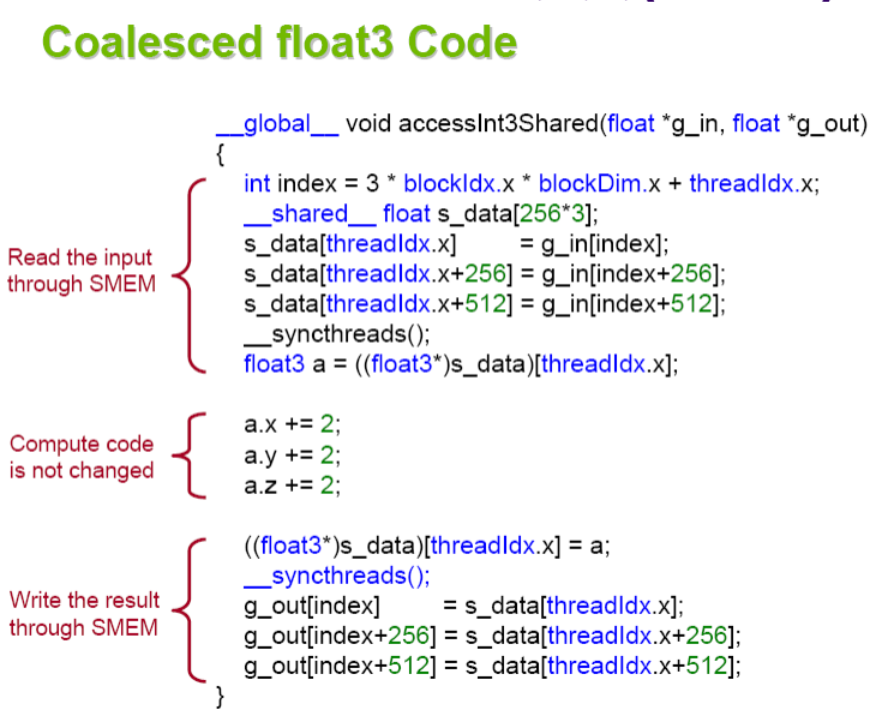
利用好每个block里的thread,全部每个线程各自读取自己对齐(Starting address for a region must be a multiple of region size 不一定是自己用的)数据到shared memory开辟的总空间。由于需要的数据全部合力读取进来了,计算时正常使用需要的读入的数据。
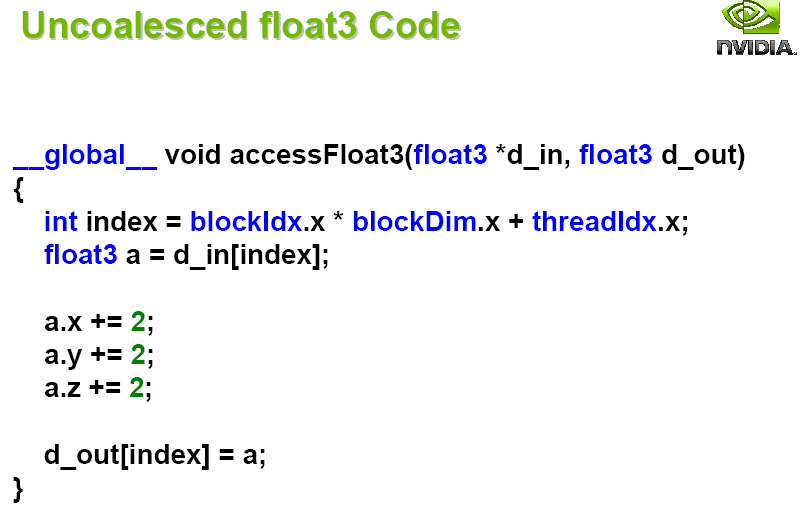
特别是对于结构体使用SoA(structure of arrays)而不是AoS(array of structures),
如果结构体实在不能对齐, 可以使用 __align(X), where X = 4, 8, or 16.强制对齐。
利用好Shared Memory
- 比globalMemory快百倍
- 可以来避免 non-Coalesced access
- SM的线程可以共享
- Use one / a few threads to load / compute data shared by all threads
隐藏延迟的方法
- 增加SM上线程数量,
- block数> SM数,这样所有的multiprocessors至少有一个block执行
- threads/block>128 。原因:机器上一般有最多4个Warp调度器=4*32=128
- threadsInblock=N*WarpSize=N*32
- 在 SM 上的 TB 越多越好,让 Thread Block 不停的跑我们的利用率就会高。
- 但是如果 Thread Block 太多,我们每一个 SM 能分配的寄存器就会变少,所以就会发生 Register Spill, 使用更高级的 L1、L2 Cache 去代替 Registers。所以 TB 不能太多,需要减少 Register Spill 的次数。
- 资源占用率不要太高(最多一半?
- 多使用
__syncthreads - 最好的参数需要
self-tuning出来
占用率高不一定是好事
占用率是指每个多处理器(Streaming Multiprocessor,SM)的实际的活动warps数量与最大理论的warps数量的比率。
高的占用率不一定能提升性能,因为这一般意味着每个线程分配的寄存器和shared memory变少。但低的占用率会导致内存延迟无法隐藏。
实际需要计算每个线程大概需要的shared memory和register数量
实际例子测试-待研究
https://www.cnblogs.com/1024incn/p/4541313.html
https://www.cnblogs.com/1024incn/p/4545265.html
优化实例1 - 矩阵转置
通过SMEM实现coalescing access
原本代码
1 | _global__ void transpose_naive(float *odata, float *idata, int width, int height) |
思想:将大矩阵划分成方块,并且存储在SMEM里。不仅SMEM速度更快,而且每行元素个数变少,跨行访问的间距变小,局部性增强。而且对于大矩阵加速效果会更明显。
1 | __global__ void transpose(float *odata, float *idata, int width, int height) |
coalescing access
when Block/tile dimensions are multiples of 16 ???
关于bank conflict
https://developer.nvidia.com/blog/efficient-matrix-transpose-cuda-cc/
对于一个32 × 32个元素的共享内存块,一列数据中的所有元素都映射到相同的SMEM bank ,导致bank conflict 的最坏情况:读取一列数据会导致32路的存储库冲突。
幸运的是,只需要将tile的元素宽度改为33,而不是32就行。
优化实例2 - 数据归约
具体问题:将长数组的所有元素,归约求和为一个结果。[^1][^2]
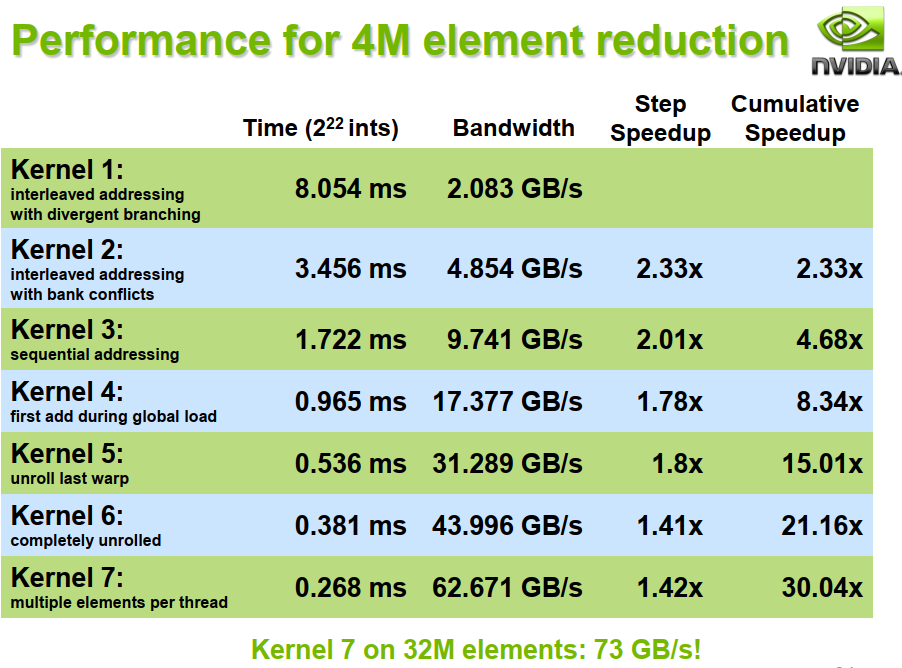
总体思路
为了避免全局同步的巨大开销,采取分级归约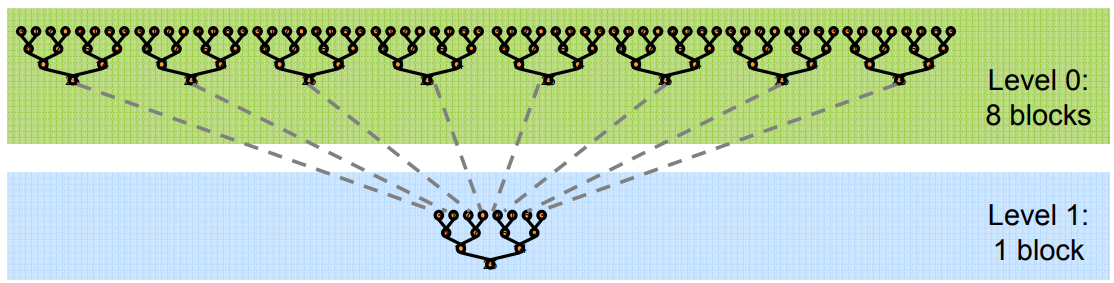
由于归约的计算密度低
1 flop per element loaded (bandwidth-optimal)
所以优化目标是将访存带宽用满。
1 | 384-bit memory interface, 900 MHz DDR |
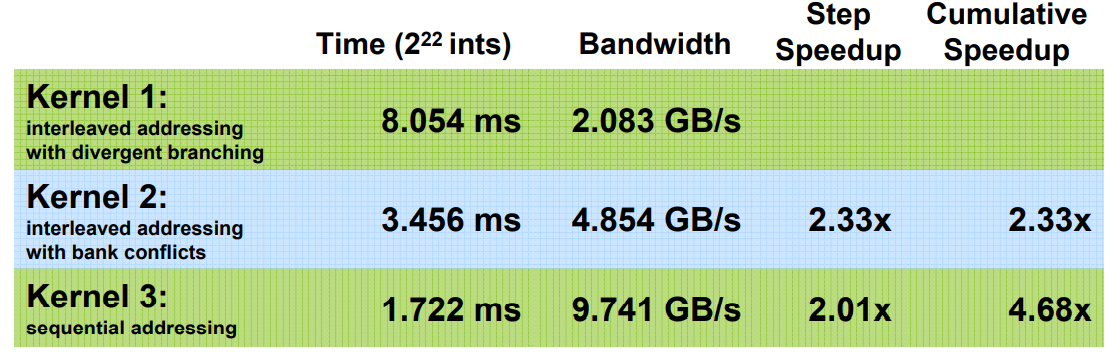
step0 : baseline - Interleaved Addressing 交错/间隔寻址
1 | __global__ void reduce0(int *g_idata, int *g_odata) { |
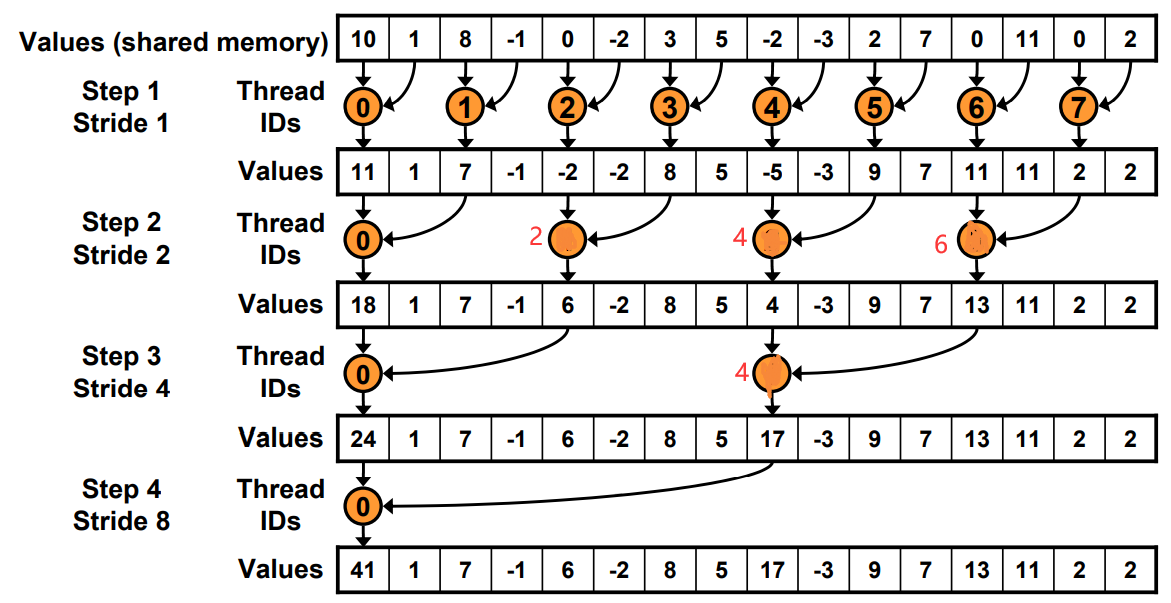
工作的线程越来越少。一开始是全部,最后一次只有thread0.
Step1 : 使用连续的index
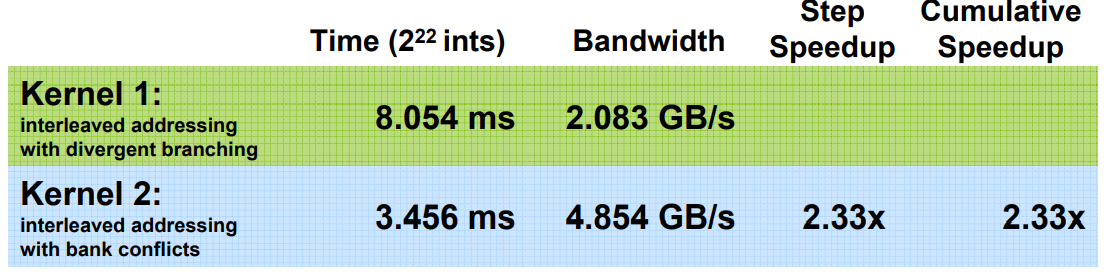
Just replace divergent branch With strided index and non-divergent branch,但是会带来bank conflict。
原理和Warp发射有关,假如在这里每个Warp并行的线程是2。一个Warp运行耗时为T.
Step0: 4+4+2+1=11T
Step1: 4+2+1+1=8T
1 | for (unsigned int s=1; s < blockDim.x; s *= 2) { |
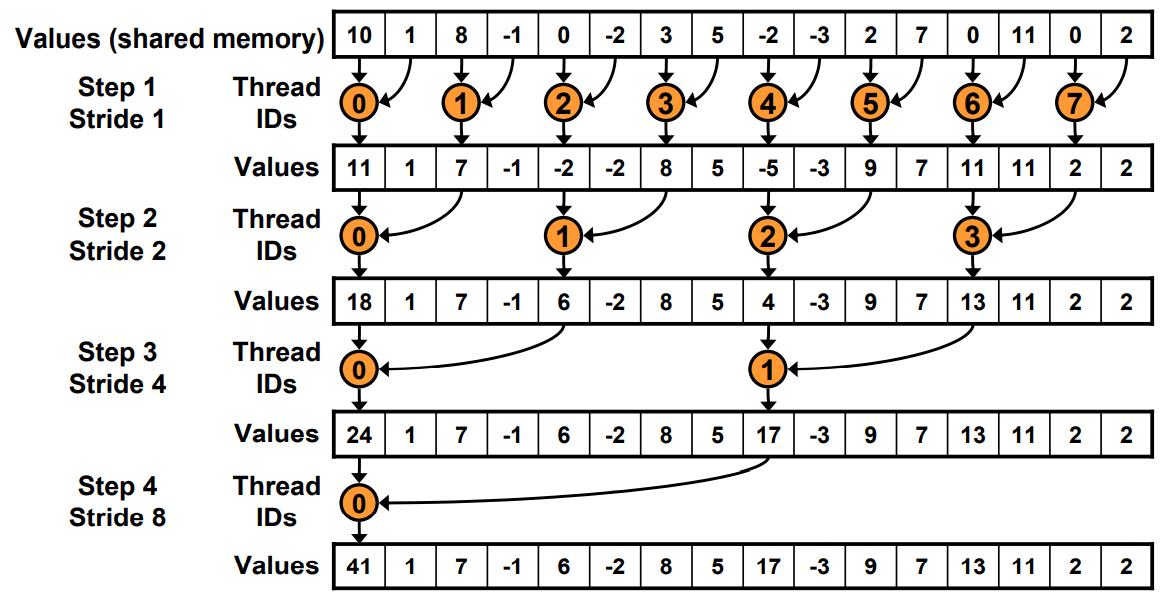
Step2: 连续寻址
1 | for (unsigned int s=blockDim.x/2; s>0; s>>=1) { |
原本寻址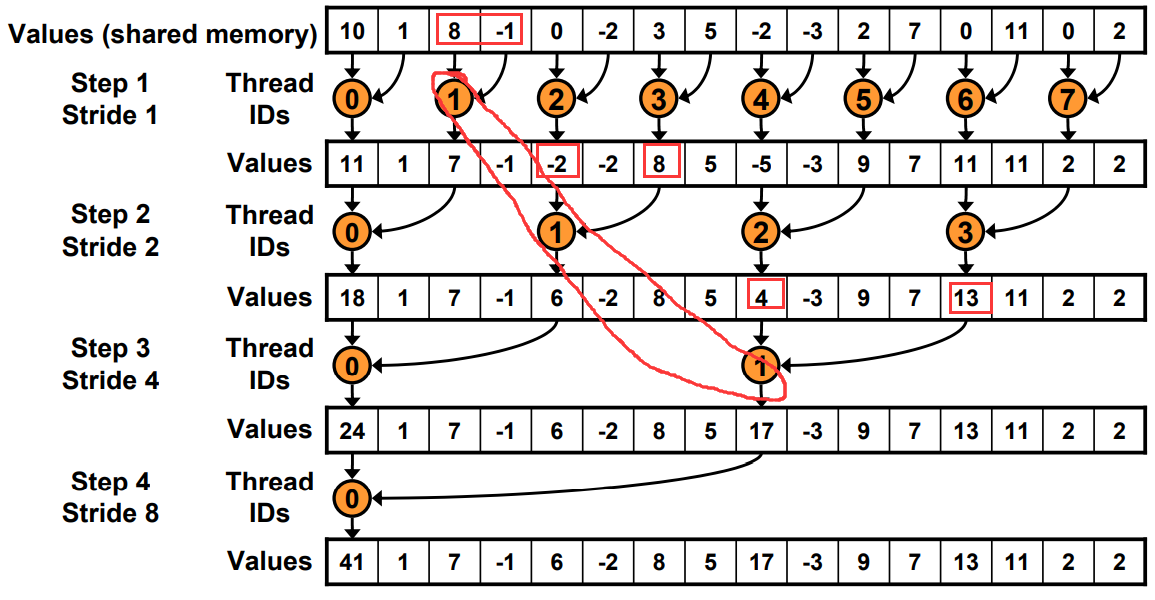
现在寻址有一边连续了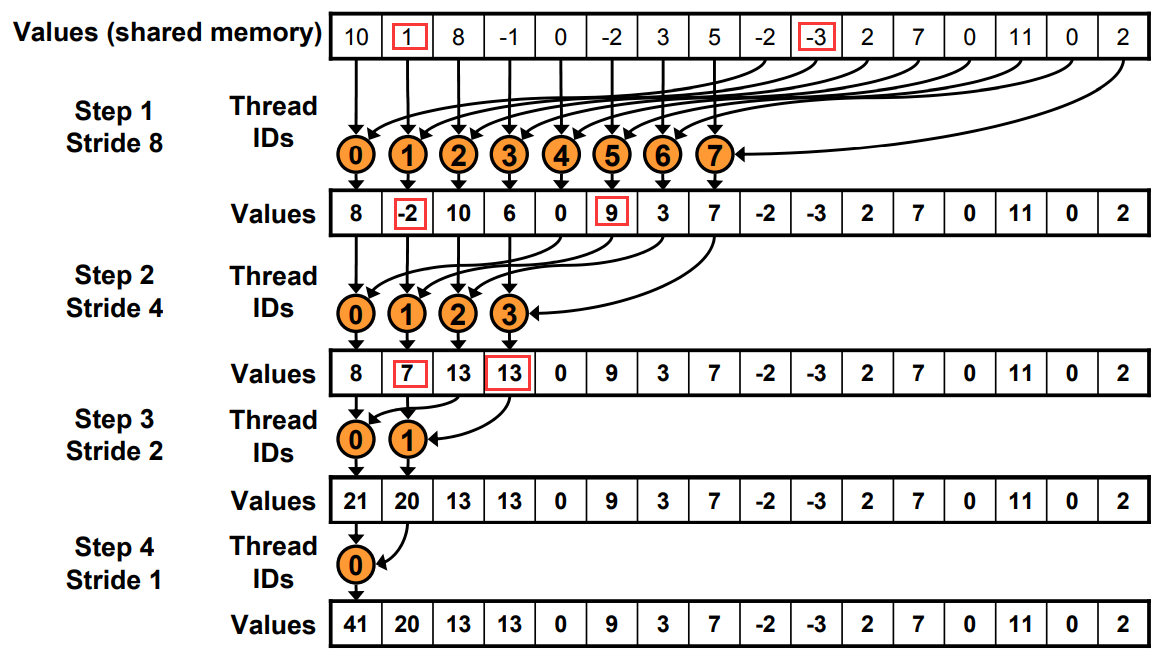
Step3 : 弥补浪费的线程
方法: 在load SMEM的时候提前做一次规约加法,通过减少一半的block数,将原本两个block里的值load+add存储在sum里。
1 | // perform first level of reduction, |

step4 : Unrolling the Last Warp
当s< 32的时候,就只有一个Warp工作了。
使用warp的SIMD还省去了__syncthreads()的麻烦
1 | for (unsigned int s=blockDim.x/2; s>32; s>>=1) |
为了保持整洁,最后一个if还做了无效的计算。eg, Warp里的最后一个线程只有第一句命令有用。
Step5 : 根据blockSize完全展开for和去除代码
由于for循环里是二分的,而且小于32的单独处理了,导致for循环里实际运行代码最多就3句。
利用代码模板和编译器的自动优化实现:
1 | template <unsigned int blockSize> |
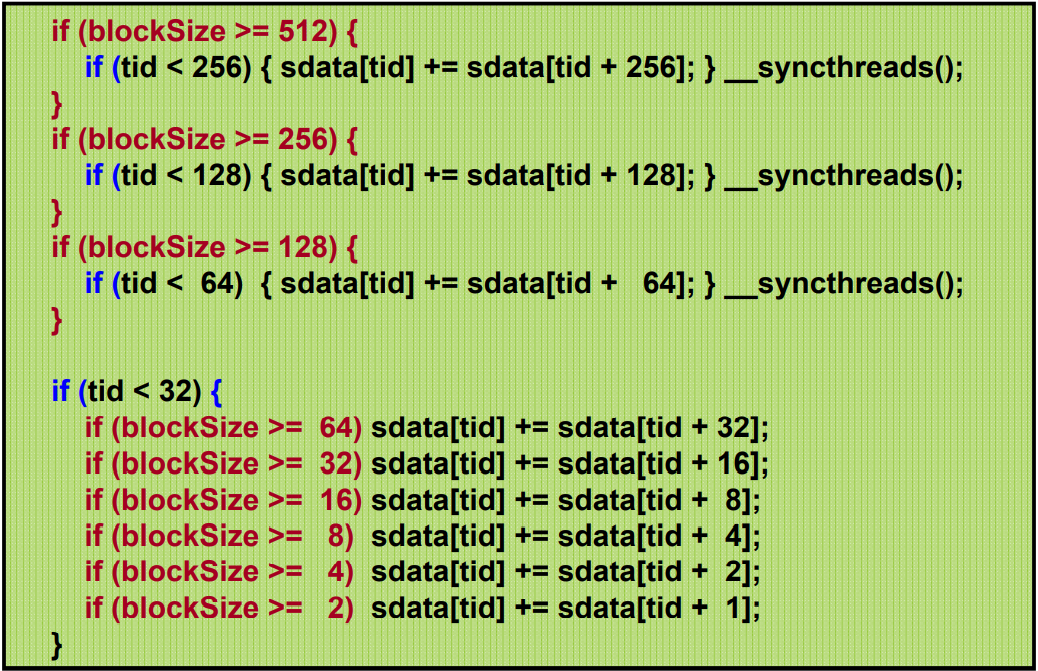
红色代码会在编译时自动优化。
step6 :归并算法优化
加速级联??
Cost= processors × time complexity
我们知道N个元素直接二叉树归约是O(log N)
时间 Cost=N*O(log N).
但是假如只有P个线程先做N/P的串行加法, 然后是log(P)的归约。
总cost=P(N/P+log(P))
当P=N/log(N), cost=O(N)
each thread should sum O(log n) elements来设置
比如,1024 or 2048 elements per block vs. 256 线程。每个sum n=4个元素。 具体参数要perf
1 | unsigned int tid = threadIdx.x; |

final code
1 | template <unsigned int blockSize> |
关于if语句的补充
有if语句是没问题的,只要运行的时候全部执行if或者else就行。不要有些执行if,有些执行else,这才会等待。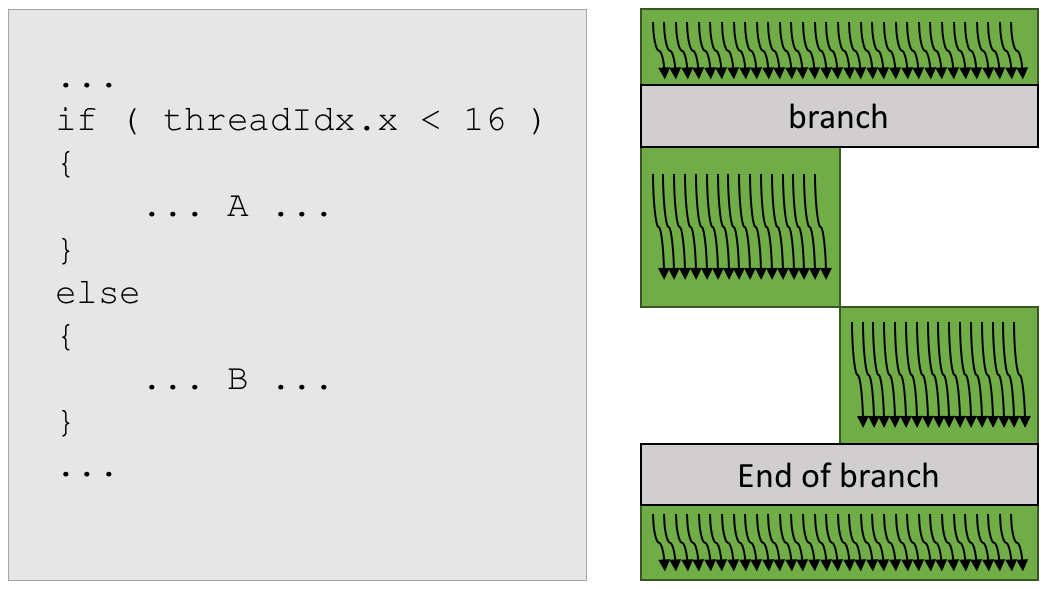
说不定也不是全部执行if或者else就行,只需要连续32个Thread Index,是相同的执行就行。(猜想,需要测试。
关于延迟隐藏
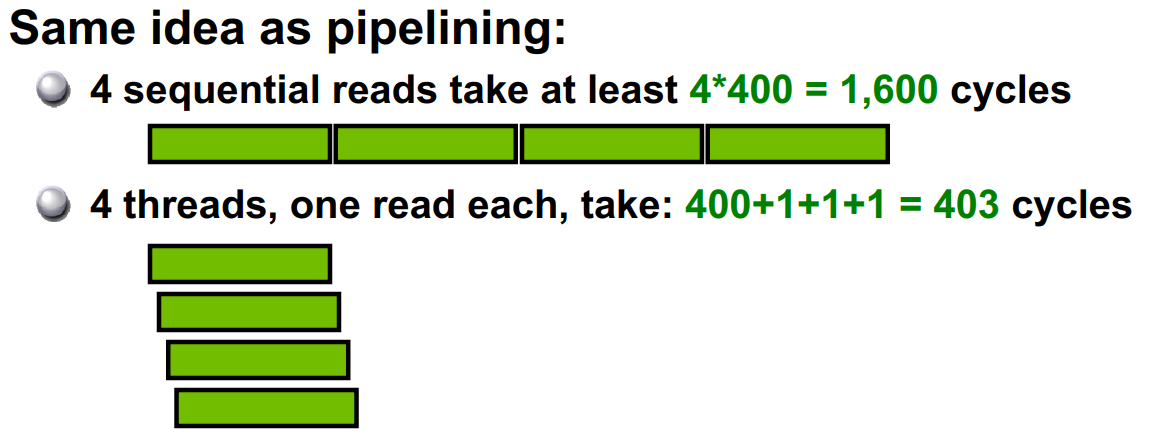
通过增加block里的线程数,并且同时读取来隐藏延迟。 不仅可以隐藏Global Memory的延迟,还可以隐藏写后读的延迟
线程资源查看
线程太多会导致分配到每一个的寄存器和SMEM变少
通过编译时加-cubin选项,.cubin文件前几行会显示
1 | architecture {sm_10} |
参考文献
[^1]: SC07 Optimizing Parallel Reduction in CUDA - Mark Harris
[^2]: 2009 清华 邓仰东 cuda lecture pdf 注意也是参考的SC07 Nvidia。
安装
1 | $ which nvprof |
基本使用
摘要模式
命令行直接运行
1 | nvprof ./myApp |
跟踪API
1 | nvprof --print-gpu-trace ./myApp |
保存在log里
1 | sudo /usr/local/cuda/bin/nvprof --log-file a.log --metrics achieved_occupancy /staff/shaojiemike/github/cutests/22-commonstencil/common |
可视化
- nsight可以直接在远程机器上运行
- ssh -X host
- .ssh/config
- add
- XAuthLocation /opt/X11/bin/xauth #for macbookAir
- ForwardX11Trusted yes
- ForwardX11 yes
- Visual Profiler也可以ssh直接连接远程机器
- 或者导出分析结果以便可视化, 在Visual Profiler使用
1 | nvprof --export-profile timeline.prof <app> <app args> |
profile kernel
1 | sudo /usr/local/cuda/bin/ncu -k stencil_kernel -s 0 -c 1 /staff/shaojiemike/github/cutests/22-commonstencil/best |
ncu-ui是可视化界面,但是没弄懂
带宽profile
上限测量
1 | # shaojiemike @ snode0 in ~/github/cuda-samples-11.0 [16:02:08] $ ./bin/x86_64/linux/release/bandwidthTest [CUDA Bandwidth Test] - Starting... Running on... Device 0: Tesla P40 Quick Mode Host to Device Bandwidth, 1 Device(s) PINNED Memory Transfers Transfer Size (Bytes) Bandwidth(GB/s) 32000000 11.8 Device to Host Bandwidth, 1 Device(s) PINNED Memory Transfers Transfer Size (Bytes) Bandwidth(GB/s) 32000000 13.0 Device to Device Bandwidth, 1 Device(s) PINNED Memory Transfers Transfer Size (Bytes) Bandwidth(GB/s) 32000000 244.3 Result = PASS NOTE: The CUDA Samples are not meant for performance measurements. Results may vary when GPU Boost is enabled. # shaojiemike @ snode0 in ~/github/cuda-samples-11.0 [16:03:24] $ ./bin/x86_64/linux/release/p2pBandwidthLatencyTest |
实际值
nvprof通过指定与dram,L1或者L2 的metrics来实现。具体解释可以参考官网
在 Maxwell 和之后的架构中 L1 和 SMEM 合并
| Metric Name | 解释 |
|---|---|
| achieved_occupancy | 活跃cycle是 Warps 活跃的比例 |
| dram_read_throughput | |
| dram_utilization | 在0到10的范围内,相对于峰值利用率,设备内存的利用率水平 |
| shared_load_throughput | |
| shared_utilization | |
| l2_utilization |
需要进一步的研究学习
暂无
遇到的问题
暂无